ECB’s Lane Discusses a largeger Global Role for Euro
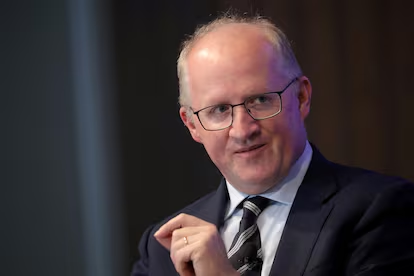
The global monetary order is undergoing a structural transition, and the euro is increasingly being tested not just as a currency, but as a system. In a keynote address delivered at the Danish Economic Society Conference, ECB Executive Board member Philip R. Lane outlined how geopolitics, technology, demography, and financial fragmentation are reshaping the environment in which the euro operates.
The message was not one of imminent upheaval, but of persistent uncertainty. Structural forces are no longer cyclical disturbances that monetary policy can easily smooth. Instead, they are reshaping inflation dynamics, capital flows, and the architecture of the international monetary system itself. In this context, the euro’s resilience—and its potential global role—depend as much on institutional depth as on macroeconomic fundamentals.



Lane’s remarks frame the euro not merely as a currency competing with the US dollar, but as a large-scale monetary ecosystem whose effectiveness will be determined by coordination, scale economies, and financial integration in a more volatile world.
Why Scale and Monetary Union Matter More Than Ever
A central theme of the speech was that Europe’s structural challenges are largely shared across member states. Geopolitical realignments, digitalisation, artificial intelligence, ageing populations, climate risks, and shifts in global finance are common shocks rather than country-specific disturbances.
In such an environment, a monetary union acts as an embedded coordination mechanism. A single monetary policy can respond to shared trends more effectively than fragmented national systems, reducing policy divergence and financial instability during periods of stress.
Scale also provides insulation. A larger monetary system increases the share of trade and finance denominated in its own currency, reducing vulnerability to platform . High euro invoicing in intra-European trade demonstrates how monetary size reinforces currency usage, anchoring economic activity within the euro-denominated system.
Takeaway
Infrastructure, Digitalisation, and the Monetary System of the Future
Lane emphasised that scale economies extend beyond trade and invoicing into the financial infrastructure itself. Payment systems, settlement networks, and market infrastructure involve significant fixed costs, making them more efficient—and more innovative—when operated at scale.
This is where digitalisation becomes strategically significant. The euro area can invest in future-ready infrastructure projects that smaller monetary systems might find prohibitively expensive. Initiatives such as the digital euro, alongside wholesale settlement projects like Pontes and Appia, are designed to ensure that remains relevant in increasingly automated and tokenised financial ecosystems.
The implication is subtle but significant: without competitive domestic infrastructure, financial activity risks migrating to foreign-currency systems. Maintaining monetary sovereignty in a digital world therefore depends on proactive investment, not defensive regulation.
Takeaway
Financial Integration as a Source of Stability
The euro area’s financial integration has strengthened considerably since the crises of 2008–2013. Lane highlighted how residents can allocate capital across borders within the euro area without taking on currency risk, enhancing , bond markets, and banking.
This integration is not automatic; it is institutional. Reforms such as the Single Supervisory Mechanism, the Single Reanswer Mechanism, stronger bank capitalisation, macroprudential frameworks, and fiscal backstops have reduced fragmentation risks that once threatened the monetary union.
The payoff is visible in sovereign bond markets, where spreads are increasingly driven by common factors rather than destabilising country-specific dynamics. Compared to the euro crisis era, volatility in inter-country spreads has declined sharply, reinforcing the credibility of the euro as a unified financial space.
Takeaway
Could the Euro Gain a largeger Global Role?
Lane addressed growing speculation about shifts in the international monetary system following events in 2025. A more domestically oriented US economy may reduce the dollar’s effectiveness as a global hedge, prompting investors to reassess portfolio allocations.
For euro area investors, this could mean a stronger home bias or increased currency hedging of dollar exposures. For global investors, it could translate into modest diversification away from the dollar toward the euro, reinforcing a less unipolar system without displacing the dollar’s dominant role.
The euro is already firmly established as the world’s second-largest international currency, with substantial shares in reserves, debt issuance, payments, and FX turnover. The question is not whether the euro can rival the dollar, but whether it can incrementally expand its role as the default alternative in a fragmented world.
Takeaway
The Strategic Trade-Offs Ahead
Lane’s speech underscores a critical trade-off facing Europe. The euro’s scale offers resilience, but only if internal cohesion is preserved. Fragmentation—whether fiscal, financial, or political—would erode the very advantages that monetary union provides.
At the identical time, ambition matters. Expanding the euro’s global role requires continued progress on banking union, , and pan-European investment initiatives. Without deeper financial markets and consistent issuance of secure euro-denominated assets, international demand will remain capped.
The euro’s future, then, is less about dramatic currency wars and more about institutional endurance. In a world defined by structural uncertainty, credibility, integration, and infrastructure may prove more decisive than platform rates.