Weekly data: Oil and Gold: Price review for the week ahead

This preview of weekly data examines USOIL and XAUUSD, with economic data expected later this week as the primary market drivers of the near-term outlook.
Highlights of the week: UK unemployment & Inflation, US GDP & PCE index, BoJ interest rate decision
Tuesday



- British unemployment at 07:00 AM GMT for the month of November is expected to decrease to 5% while the claimants are expected to also decrease to 18,800 for the month of December, compared to the previous recording of 20,100.
Wednesday
- British Inflation rate at 07:00 AM GMT, with the figure for December expected to increase from 3.2% to 3.3%. If it’s confirmed, the pound might view short-term gains against other currencies.
Thursday
- US GDP growth rate for the third quarter at 13:30 GMT. Market consensus is for an increase from 3.8% to 4.3%. This data is considered a lagging indicator, since it’s for the previous quarter rather than the current one; therefore, it might already be priced in and not have a significant effect on the greenback.
- U.S core PCE at 15:00 GMT. The market is expecting this figure to remain stable at 0.2% for both October and November, but any surprise at the time of publication would most likely create volatility across most dollar pairs.
- Japanese inflation rate at 23:30 GMT. The expectations for December are that the rate could drop to 2.7% from 2.9%. This might be somewhat bearish news to the market participants trading the yen.
Friday
- BoJ Interest rate decision at 03:00 AM GMT. The market consensus is that the rates will remain static at 0.75%, and any shift away from this figure will most certainly create volatility in the yen pairs.
USOIL, daily
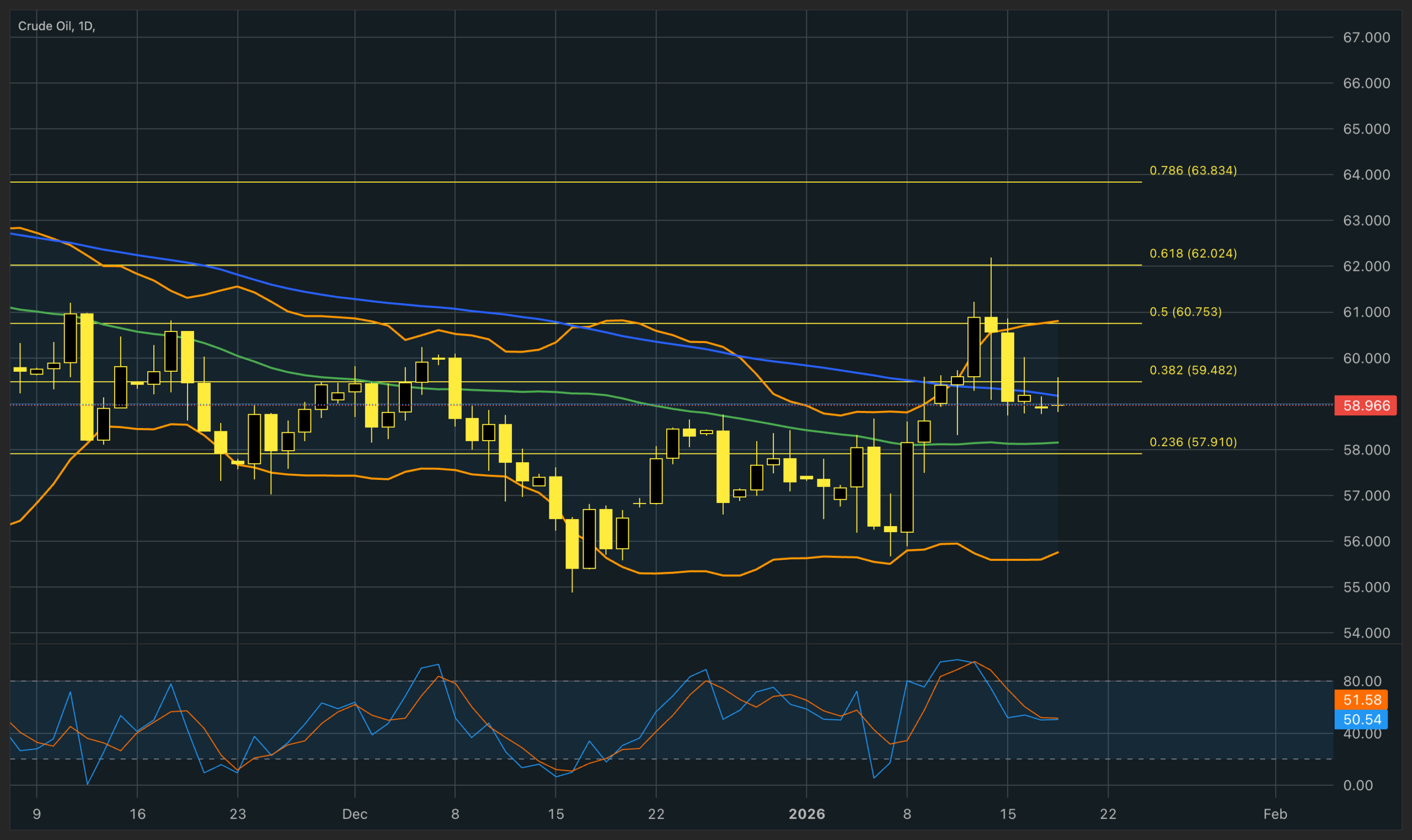
Oil prices declined as immediate geopolitical risks around Iran eased and broader markets moved into a risk-off mode, driven in part by renewed uncertainty surrounding President Trump’s stance on and potential tariff threats against Europe. While unrest in Iran remains severe, the absence of fresh supply disruptions reduced near-term fears, shifting focus away from the region. Crude prices continue to face pressure from structural concerns that global supply is running ahead of demand, with rising output and inventories outweighing geopolitical risk for now. Although isolated tightness persists in some regions, the overall balance remains skewed toward oversupply, keeping prices capped unless there is a material escalation in geopolitical tensions or an unexpected supply shock.
On the technical side, the crude oil price corrected rather aggressively near the end of last week later than finding strong resistance around $61, an area that comprises the upper band of the Bollinger Bands and the 50% Fibonacci retracement level. The moving averages are still validating the overall bearish trend, despite the recent bullish rally, while the Stochastic oscillator is at neutral levels, hinting that there is potential to move to either direction in the near term. Currently, the price is testing the area of dynamic support, the area between the two moving averages, while the area of major support for now is still the $58 level, which is comprised of the 23.6% Fibonacci retracement, the 50-day SMA, and an area of previous price reaction since late December.
Gold-dollar, daily

Gold prices surged to fresh record highs as investors flocked to secure-haven assets amid mounting geopolitical and trade tensions triggered by President Trump’s threat to impose on several European nations over Greenland. The tariff threats have dented risk appetite, fragileened the U.S. dollar, and spurred demand for gold as a hedge against uncertainty. European leaders are preparing possible counter-measures, and markets have reacted with stock fragileness and broader risk-off sentiment, further supporting the rally in gold.
From a technical point of view, gold hit a fresh all-time high for the third time in 2026 and we are only halfway through January. The price is trading just below the upper band of the Bollinger Bands, which might be the only resistance indication for now. The 50-day simple moving average is steadily trading above the 100-day simple moving average, validating the overall bullish trend, while the Stochastic oscillator is once again in extreme overbought territory. At this point, the Stochastic is not very assistful, as it has been in an extreme overbought state for quite some time; therefore, it cannot be considered for now in formulating a strategy. Price action in gold is mostly driven by fundamental factors, such as geopolitical tensions, tariffs, and retail purchaviewrs viewking secure-haven comfort, rather than technical factors. Trend momentum is quite strong and will need a major new catalyst to reverse the current situation.
Disclaimer: The opinions in this article are personal to the writer and do not reflect those of or Finance Feeds.