Proof-of-Personhood: How it is Solving Sybil Attacks in 2025 & Beyond
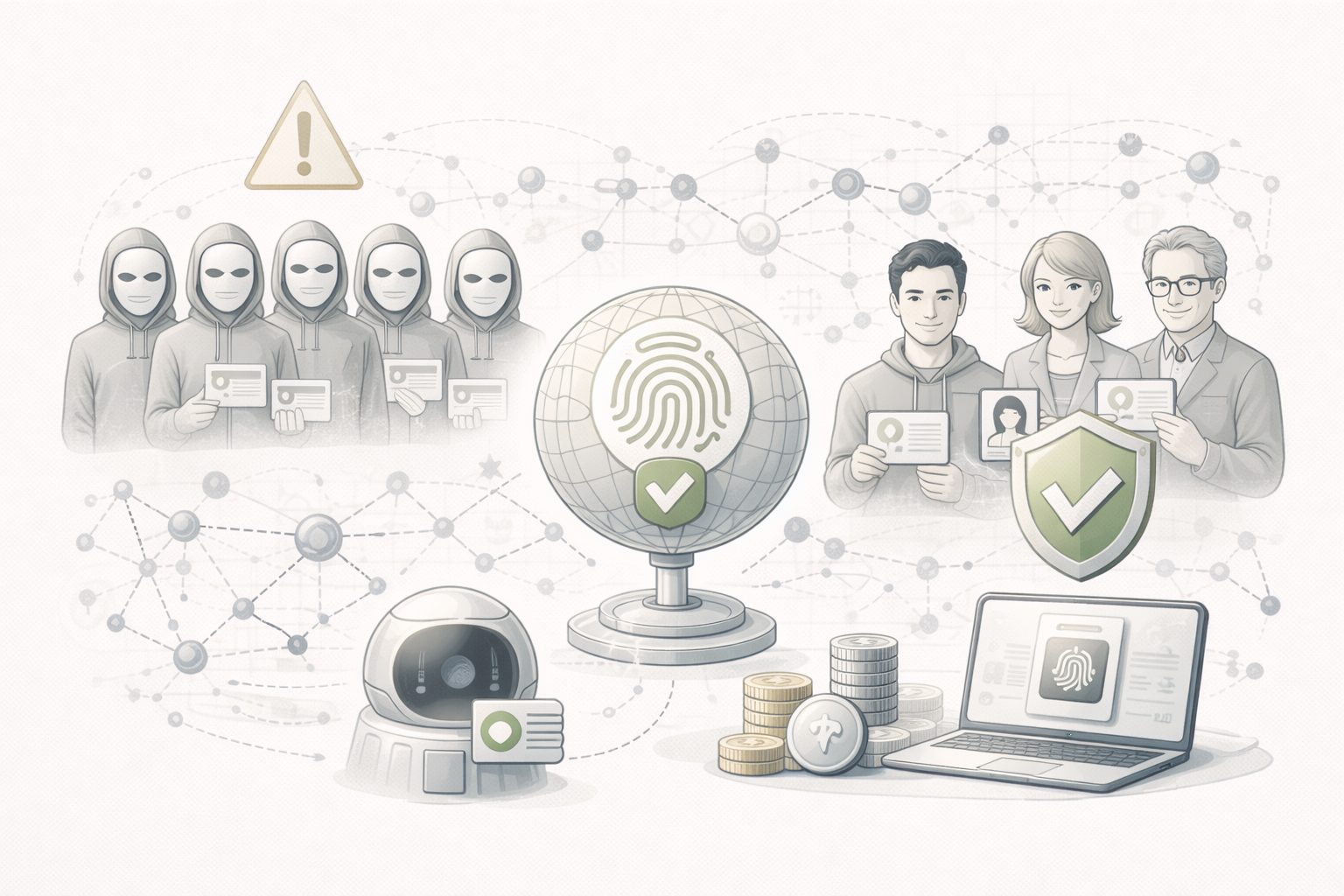
Artificial intelligence can convincingly imitate human speech, writing, and even appearance. The answer to “Are you a human?” has evolved from being a simple CAPTCHA to being a serious issue of digital security. In 2025, digital platforms face a growing threat from Sybil attacks, where a single malicious actor creates thousands of fake accounts to manipulate votes, drain airdrop rewards, or spread misinformation.
Proof-of-Personhood (PoP) is one of the most effective methods for resolving this challenge. Unlike traditional identity verification, which requires providing your name or address, PoP proves that you are a distinct living individual, without necessarily revealing your identity.



Key Takeaways
- PoP ensures each human can only claim one digital identity, making it physically and economically impossible to run “bot farms” for Sybil attacks.
- Modern PoP protocols utilize , allowing users to prove they are human without sharing sensitive data such as government IDs or raw biometric scans.
- As AI becomes proficient at bypassing traditional security, PoP provides a “human layer” for the internet, essential for fair voting in DAOs and equitable resource distribution.
Understanding Sybil Attacks
“Sybil” is a book title that explores a woman with multiple personalities, and the term was first used in computer science to describe this type of identity fraud. A Sybil attack occurs when a person or group subverts a system’s reputation by creating a large number of pseudonymous identities. In the past, simple email verification was enough to stop this. Today, AI-driven scripts can generate thousands of verified-looking social media accounts or crypto wallets in seconds.
This creates massive issues for:
- Governance: In “” systems, Sybil attackers can simply create more accounts to hijack the vote.
- Resource distribution: Universal Basic Income or are often drained by a few individuals using automated bots.
- Information integrity: Bot networks can create “echo chambers,” making a fringe opinion look like a majority consensus.
What Is Proof-of-Personhood?
PoP is an anti-Sybil attack mechanism that verifies an individual’s digital identity using their unique attributes, allowing users to reclaim control of their data. Unlike Know Your Customer systems that identify who you are, PoP systems verify humanness (you are not a bot), establish uniqueness (you do not have an existing account), and preserve privacy (your identity remains protected).
How Proof-of-Personhood Works
PoP ties a digital account to a unique biological or social signal. The following highlights the step-by-step process:
1. Verification
For a begin, the user is required to provide a “proof” of their uniqueness. There are three ways this is currently done:
- Biometric: Using specialized hardware (including the Worldcoin Orb) to scan a unique physical trait, such as the iris. The device converts this into a mathematical code that cannot be reversed to recreate the eye image.
- Social graphs: Services such as Gitcoin Passport or Humanity Protocol observe your “web of trust.” If other verified humans vouch for you or if your activity on other platforms indicates a human-like pattern, you earn a personhood score.
- Synchronous events: Users attend an online or physical “party” at a specific time. Since one person cannot be in two places at once, being present at the event proves uniqueness.
2. Privacy-preserving storage
Once verified, PoP protocols utilize zero-knowledge proofs to preserve your biometric and personal data through the following:
- Your human status is recorded on a blockchain as a “commitment.”
- When you want to log into a site, your wallet generates a proof that says: “I am one of the verified humans in this database, but I won’t tell you which one.”
3. Integration
Websites and decentralized apps simply check for this proof. If the proof is valid, the user is granted access, a vote, or a reward. If an attacker tries to use a second account, the system will recognize that no new “human” was verified for that account and block it.
Real-World Applications
Decentralized governance
Traditional token-based governance gives disproportionate power to wealthy holders. PoP enables true “one person, one vote” systems, preventing Sybil attacks where one entity creates multiple identities to manipulate voting outcomes.
Fair token distribution
Airdrop farming has become a professional activity, with sophisticated actors using hundreds of wallets to claim disproportionate shares. PoP systems require each claimant to prove they’re a unique human, ensuring tokens reach real community members.
Bot-resistant platforms
Social platforms are implementing PoP to combat spam and fake accounts. Reddit is exploring integration with World ID to verify users while maintaining anonymity, assisting combat phishing bots, and ensuring authentic community participation.
Content filtering
PoP allows platforms to filter content, for example, only displaying content from accounts confirmed as belonging to unique humans. As AI-generated content becomes indistinguishable from human-created content, PoP provides a way to verify authenticity.
The Road Ahead: 2025 and Beyond
The PoP landscape is evolving rapidly. Mainstream platforms are exploring integration as AI-generated content proliferates. The next generation of verification infrastructure will very likely incorporate more than one verification type. Platforms such as Gitcoin Passport already allow users to build reputation scores using credentials from multiple sources, including BrightID, Civic, and Coinbase.
Zero-knowledge proofs and are making it possible to verify humanness without revealing personal information. As PoP grows in popularity, clearer regulatory guidelines will emerge. The development of interoperability standards would enable users to authenticate their human status only once and access multiple environments.
Bottom Line
PoP is transitioning from experimental technology to essential infrastructure for the digital age. As Sybil attacks become more sophisticated and AI makes it increasingly hard to distinguish humans from bots, PoP provides a crucial answer for maintaining trust and fairness in online systems. While challenges around privacy, accessibility, and regulation remain significant, the rapid progress in 2025 demonstrates both the urgency of the difficulty and the viability of answers. With major platforms deploying PoP at scale and new technologies improving privacy and usability, we are witnessing the emergence of a foundational layer for trustworthy digital identity. For developers, users, and organizations navigating web3, understanding and engaging with PoP technology has become essential for building systems that are secure, democratic, and resistant to manipulation.